- M. Montessori
The Green Mountain Montessori School subscribes to the beliefs and guiding philosophy of Maria Montessori, an early 20th century physician and educator. Montessori believed that young children — specifically, children up to the age of six — had what she called "absorbent minds," minds able to assimilate information from the environment as if by osmosis.
Overview of Montessori materials
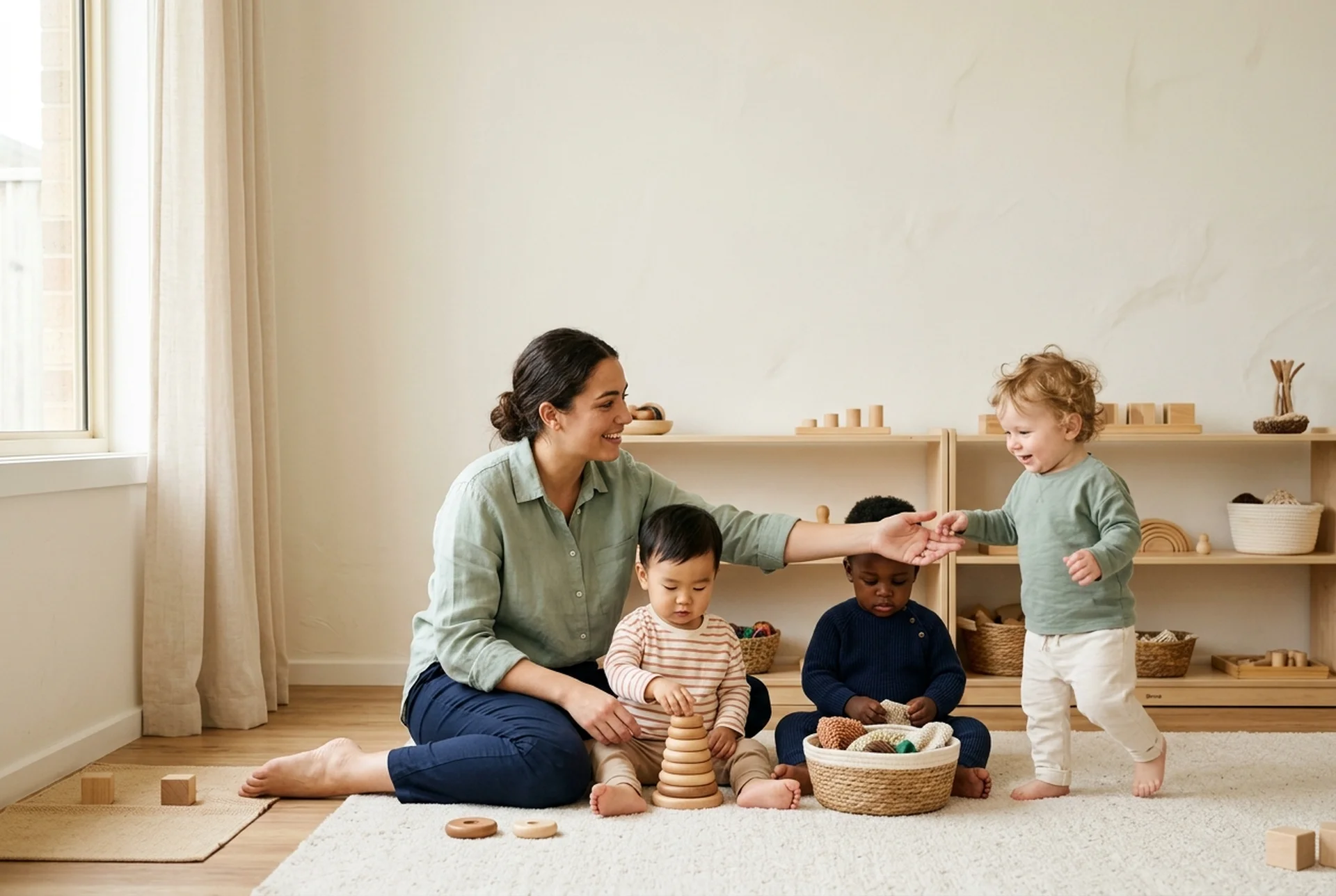
Materials sit on low, open shelves, simple and attractive, so a child can reach and choose. They are beautiful where possible and sometimes color coordinated, like the blue stoneware pitcher and basin used for table washing. Each material makes an idea concrete: single beads for units, ten strung on wire for a ten. The child moves from handling beads to writing numerals on paper, grounded in real experience, not rote.
Practical life exercises:
Practical life covers care of self and the room, grace and courtesy, and movement. Real child-size utensils let a child zip, pour, cut, or greet a visitor. The work has a direct aim, like arranging flowers, and an indirect one, like estimating a stem's length for math. Points of interest, such as the crack of a shell in nut work, hold attention. That effort builds concentration, independence, and intelligence.
Sensorial/geometric Materials:
Sensorial work refines the five senses and the stereognostic sense, the ability to know an object by touch alone. A child sorts and classifies by size, shape, color, sound, taste, texture, and smell, using the pink tower, cylinder blocks, color tablets, sound cylinders, bells, sandpaper letters, and fabric matching. Descriptive words come with each lesson. The materials correct the child's own errors, so independence grows.
Mathematics Skills:
Children count, compare, and calculate naturally. Montessori math starts simply and moves toward abstraction. Through sensorial work the child measures and analyzes, learning to judge size and quantity. Beads and other concrete materials let a young child work with hundreds and thousands before writing them, because no hierarchy holds more than nine of a kind. Addition, subtraction, multiplication, division, and fractions follow. Work usually begins near age four.
Language Materials:
Language begins with the spoken word: stories, poems, and precise naming of things. Vocabulary and grammar grow as the child hears and experiments. Sound games sharpen the ear. Writing comes next, with sandpaper letters, the sand tray, and metal insets. Then matching cards and the child's own name card. Early reading uses phonetic object boxes, reading cards, and phonogram cards. Teachers assess readiness and present what each child needs.